




Switch smartly!
Why is it worth examining our current forage crop production technology from a livestock farmer’s perspective as well? Why is it no longer enough to keep using the crop rotation that has served us well so far? Because one thing is certain these days: change. And it is those who adapt who survive.
When purchasing opportunities are limited and every year brings new environmental challenges, it is important to have solutions in our toolkit that make our production flexible, secure and profitable in the long term.
By judiciously applying the latest knowledge and innovations in our field, we can spread risk, reduce our exposure and, not least, cut our production costs. After all, nothing is more expensive than not having enough digestible fibre in the ration in summer, or having as much as 5 ha of our land lying ‘fallow’ for 2-4 months.
This short overview is intended as food for thought, presenting crops and crop rotation variations that allow us to minimise our environmental exposure while keeping our production costs in check.
For the sake of clarity, our forage crops are grouped below:
Autumn-sown forage crops

This group includes species that generally offer favourable fibre digestibility, acceptable protein content and moderate average yields, such as:
· winter cereal silages and haylages (rye, triticale, barley, wheat),
· cold-tolerant forage grasses (Westerwolds ryegrass, Festulolium, Italian ryegrass, perennial ryegrass, tall fescue, other fescues),
· legumes (vetches, forage peas, crimson clover).
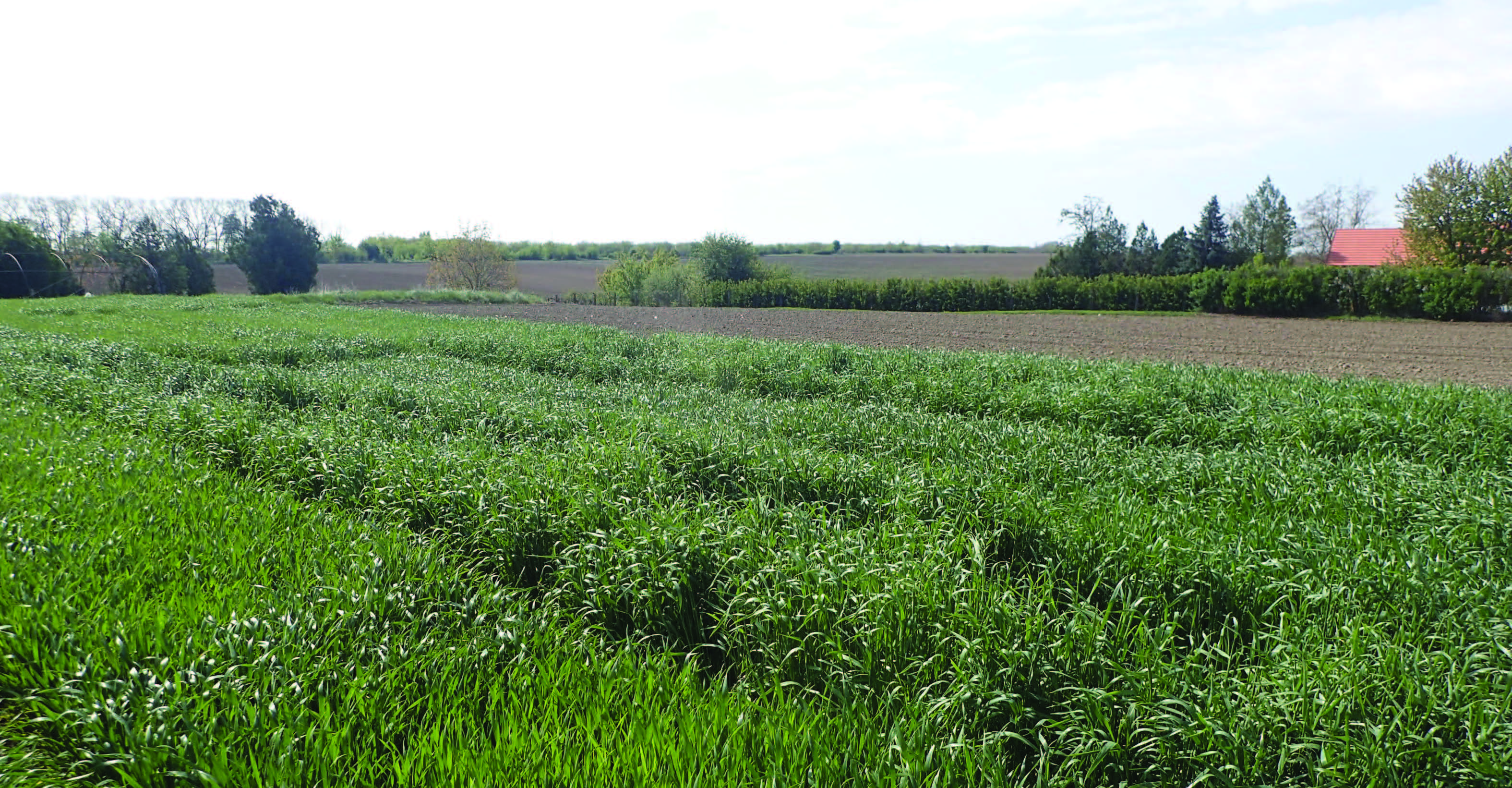
Rye harvested before heading (BBCH 45) has excellent fibre digestibility (NDFd48 approx. 70%), so it can be fed in large amounts to high-yielding dairy cows between days 1 and 200 of lactation (at least 5 kg silage/day/cow in winter, autumn and spring, and 10-15 kg silage/day/cow in summer). At this phenological stage it produces a dry matter yield of 3-8 tonnes, depending on the weather (approx. 10-25 tonnes of silage/ha at 30% dry matter content). It is important to note, however, that of the winter cereals grown in Hungary, triticale is much more flexible than rye. While rye, thanks to its genetics, can deliver outstanding yields combined with good fibre digestibility, its harvest window is unfortunately very narrow (3-5 days), harvesting falls in the changeable month of April, and in some years it suffers badly from environmental conditions (excessively high temperatures, low rainfall). Rye is therefore a forage for well-managed farms with excellent harvesting machinery. Triticale, by contrast, has a wider harvest window (7-10 days) and copes particularly well with a range of weather anomalies. Moreover, it is harvested somewhat later (late April to early May), so Sudan grass or sorghum can be sown after it (under non-irrigated conditions). Like rye, triticale harvested at the ideal phenological stage (BBCH 49) has particularly good fibre digestibility (NDFd48 approx. 75%), so it can also be fed to high-yielding cows in early lactation (days 1-100 of lactation, at 5-15 kg silage/day/cow). Triticale can also be used successfully at stages 50-51 of the BBCH scale (spikelets already visible): although its fibre digestibility is lower, the value is still favourable (NDFd48 > 70%). This fibre digestibility is still 15% better than that of maize silage, and compared with average alfalfa silage/haylage the difference is as much as 30%! At this phenological stage (late April to early May) its yield is similar to that of rye. By then, however, rye is already past its best (NDFd48 approx. 65%).
With some forage grasses, it is worth pointing out that, unlike common practice in Hungary, many other European countries keep these crops in the rotation for more than just a single cut. The best example of this is Festulolium, which has become popular in recent years. As we know, Festulolium varieties are the result of crossing fescue with ryegrass, and thanks to this they can provide forage of good quality and in good quantity for several years. In the US state of Wisconsin, which lies at the same northern latitude as Hungary and has similar weather patterns, Festulolium varieties based on perennial ryegrass × tall fescue are sometimes used continuously for 3-4 years and cut 4-5 times a year. In Hungary, by contrast, fields are often ploughed up after a single cut. Certain Festulolium varieties (mainly meadow fescue-based ones), which are well adapted to summer heat, can still be a suitable alternative, provided they can be sown in time in spring (if spring sowing is unavoidable).
If a farm’s aim is simply to sow grass in autumn for a single cut, it is worth considering Westerwolds ryegrasses, which are genetically annual and therefore deliver most of their yield potential in the first cut.
Unfortunately, perennial forage grasses are still unjustifiably undervalued in Hungary, even though they can be made into some of the cheapest feeds! Modern varieties adapt very well to intensive use and also have good agronomic traits (such as frost tolerance). These include tall fescue, whose new varieties are already widely used in Western Europe.
From a digestive physiology standpoint, intensively grown Italian ryegrass, Festulolium and Westerwolds ryegrass are the very best forages for the cow (NDFd48: >75%, crude protein: >17% DM, initial sugar content: 15-20% DM). Fed in large quantities, grasses prove to be the best feed during periods of heat stress. So from the cow’s point of view, it’s a big YES! The key is to find the right place for them in the crop rotations of dry continental regions. Because this is where they belong!
As for legumes, it is important to point out that none of them performs well in pure stands, only in mixtures. While vetches and peas perform best with winter cereals, crimson clover makes an excellent pairing with Italian or Westerwolds ryegrass (providing outstanding protein content). The beneficial effect of legumes at an early phenological stage (around heading of the cereal) is questionable, as their share in the mixture is still small. On poor soils, however, some extra protein may be gained. Overall, at an early phenological stage, sowing a mixture is not necessarily justified compared with pure cereals and grasses (since rye, triticale and Italian ryegrass can deliver similar results on their own). Later on, however, at the end of the milk stage, when the mixture has a dry matter content of at least 30% and ferments reliably even with single-pass harvesting, we obtain a high-yielding (40-50 tonnes/ha green yield, 6-8 tonnes/ha dry matter yield), cost-efficient, high-protein mixture (with a crude protein content of 15-18% DM). The starch content is 5-10% DM. At this stage, fibre digestibility is already poor (NDFd48 below 50%), so this mixture is not a feed for high-yielding cows but primarily for young stock. In replacement heifers (our future!), it ensures greater wither height and frame size, potentially with higher dry matter intake and milk production in later lactations. This way we truly rear our heifers rather than fatten them!
Mixtures harvested at the late milk stage of the cereal (BBCH 77-78) are excellent forage for
· replacement heifers ()
· lactating cows with medium or low production levels (<9000 kg/cow/305 days),
· lactating cows in the medium- and low-yield phase of lactation (beyond day 200 of lactation),
· beef cattle.
Spring-sown forage crops

This group includes annual or even perennial forage crops that can be grown in Hungary between April and August.
The most important of these is silage maize, sown on nearly 60,000 ha in Hungary. It is the cornerstone of Hungary’s forage supply (nearly 2 million tonnes of maize silage per year, with an average yield of 25-30 tonnes of silage/ha). The average starch content of silage maize in Hungary is 35% DM, which is essential in the dairy cattle ration (it supplies approx. 2 kg of starch per cow per day, 80% of which is degraded in the rumen). Its fibre digestibility, however, is poor at 50-55% (NDFd48), and on top of that this fibre degrades slowly (2-3%/hour). Silage maize should therefore not be regarded as a source of digestible fibre. Unfortunately, it is also particularly sensitive to summer heatwaves and early high temperatures, so successful cultivation requires sowing in April or early May. This fundamentally limits the range of possible preceding crops, making rye the main one. It is worth mentioning here that this combination creates one of the greatest risk exposures if both the rye and the maize ‘fall victim’ to drought or heat stress. We would then have neither starch and green mass nor digestible fibre available in sufficient quantity and quality. Let’s hope there will be few years like 2019, which created such a catastrophic situation in southern Hungary.
This group also includes the sorghums: silage sorghum (https://www.alfaseed.hu/product-page/silocirok-gigant), PPS sorghum (photoperiod-sensitive type) (https://www.alfaseed.hu/product-page/silocirok-jumbo-star), BMR sorghum (Brown Mid Rib type) (https://www.alfaseed.hu/product-page/bmr-cirok-monster) and Sudan grasses (https://www.alfaseed.hu/product-page/szudanifu-bovital). These crops are known for their outstanding tolerance of environmental stress. It is important to note that there is no other crop in Hungary like Sudan grass, which in summer (between April and early August) can always

be sown successfully while being easily digestible, so we can use it to replace lost digestible fibre or green mass in our forage base. It is the best emergency forage crop, one that is always worth keeping up your sleeve. It can even be sown after the wheat harvest in early August! Harvested at the right phenological stage, it provides our feed with excellent fibre digestibility (NDFd48 60-65%) and protein content.
Perennial forage crops
This group includes most grasses and alfalfa. Alfalfa on its own is considered a relatively expensive forage crop, so it is important to make the most of the land. One way to do this is to follow the example of some Western countries, where alfalfa is kept in the field for a maximum of 2 productive years, and in the year of sowing it is ‘paired’ with Italian ryegrass or even Festulolium. The advantage of this grass mixture is that it increases the fibre digestibility of the TMR and, not least, the productivity of the field. Another option is to drill a winter cereal or a perennial (or even annual) grass for haylage into our alfalfa at the end of its 2nd year, before it is terminated, using a ‘no-till’ or ‘minimum-till’ system. This way, we can still benefit from the alfalfa’s protein content at the spring cut.
In Hungary, the average crude protein content of alfalfa is 19% DM, which is ‘our own fault’. Its fibre digestibility is 40% (NDFd48), and even with excellent quality it can only approach 50%. On the other hand, this fibre degrades quickly (4-6%/hour), so it makes good use of its retention time in the rumen. Overall, therefore, although alfalfa is an important component of the high-yielding cow’s ration (because of its crude protein and soluble protein content and its structure), it should not be regarded as a source of digestible fibre.

In Tables 1-2 below, we would like to present some crop rotation systems and options which, we hope, can contribute to cost-effective and reliable forage production in Hungary.
Table 1 Crop rotation options – 100% forage crop production

Table 2 Crop rotation options – conventional cash-crop production + forage crop production.
