




Crop protection in sorghum – pests, part I.
Let’s think ahead – it’s not only our livestock that love SORGHUM!
True, we are only at the beginning of the year, but when better than now to think through the crop protection issues facing the sorghum crops we are planning for this year! Whether it’s a grain, silage, dual-purpose or Sudan grass x sorghum hybrid, one of the most dangerous pests is the APHID! But why should we pay so much attention to this tiny pest?
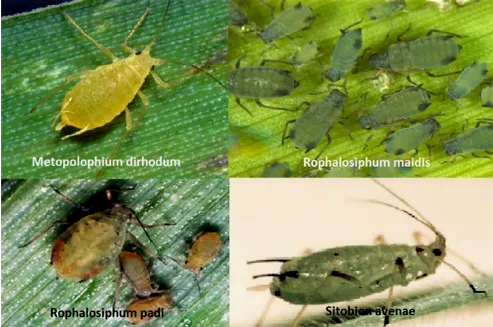
In our various sorghum crops, we most often encounter four different aphid species:
Sitobion avenae – English grain aphid
Metopolophium dirhodum – rose-grain aphid
Rhopalosiphum padi – bird cherry-oat aphid
Rhopalosiphum maidis – corn leaf aphid (Figure 1)

Figure 1: Aphid species in sorghum
The damage they cause is very similar: as they suck sap, the plant’s leaves roll up and the plant loses turgor and water. A further, far from negligible concern arising from aphid colonisation – perhaps even one of the biggest – is the transmission of plant viruses (Figure 2). As a result, reduced plant development and, later on, a decline in both the quantity and the quality of the yield can be observed in many places.

Figure 1: Aphid species in sorghum
Important steps to avoid economic damage:
1. Continuous monitoring from the 4–6 leaf stage,
2. Chemical or biological control depending on the development of the aphid population
3. Checking the effectiveness of the treatment
Among chemical products, insecticides containing the active ingredient deltamethrin, which belongs to the pyrethroid group, can be used effectively against aphids colonising the crop. However, we need to be careful, because this active ingredient does not provide long-lasting protection and is ineffective on leaf surfaces it cannot reach; it is therefore advisable to supplement the treatment with systemic active ingredients that are absorbed by the plant (e.g. thiacloprid, acetamiprid, tau-fluvalinate, etc.) (always make sure that the product in question is authorised for use in sorghum!) and to repeat the treatment as necessary in line with the growth of the aphid population!
Sorghum pests have many known natural enemies. Among the proven natural enemies of sorghum pests are various species of ladybird. Ladybirds are also effective against aphids. The most common species are the twelve-spotted ladybird (Coleomegilla maculata) and the seven-spot ladybird (Coccinella septempunctata). The common green lacewing (Chrysoperla carnea) also feeds on aphids and other soft-bodied insects. Parasites of sorghum pests include the hoverfly and the blue-banded robber fly.